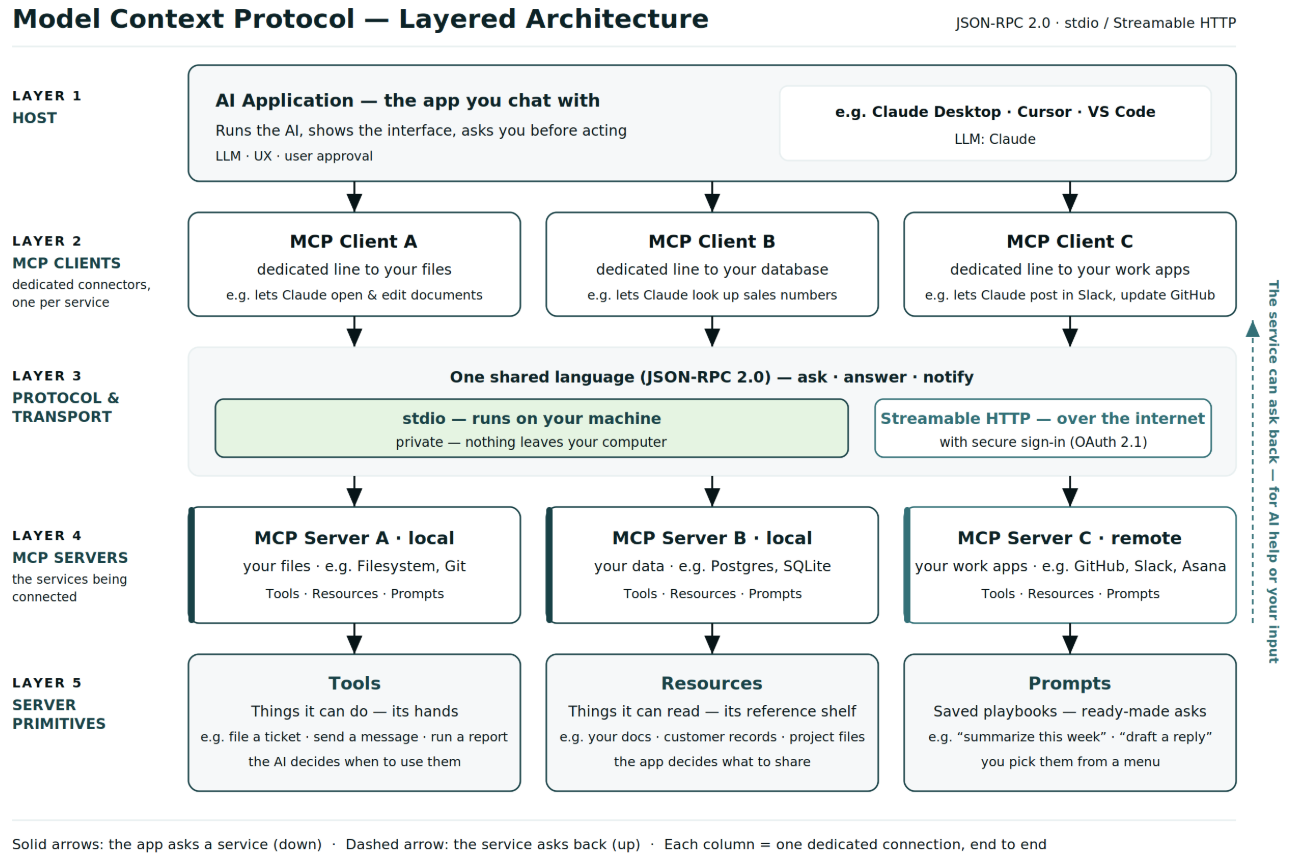
Model Context Protocol (MCP) is a standard client-server architecture that lets AI applications, agents, and models connect to external systems, and to each other, to perform actions, access data, and reuse prompt templates. It functions as the connective layer of an AI ecosystem rather than as a point-to-point integration method.
Instead of building one-off integrations for every tool or data source, MCP creates a consistent way for AI hosts, agents, and external services to communicate. The shift is wider than integration plumbing: applications no longer connect point to point, they join a network of agents, models, and systems that can discover and use each other.
Architecturally, this changes where integration happens. In the old world, each platform (a CRM, an ERP, a data warehouse) was wired through custom API code into one specific assistant, and that work was repeated for every new assistant built. In the new world, the same CRM exposes a single MCP server, and any AI host or model can connect to it. Integration moves out of the application and into the protocol layer: built once, reused everywhere.
MCP enables AI applications built on models such as Claude, Gemini, or GPT to securely discover and interact with external tools, enterprise systems, knowledge repositories, databases, and APIs through a standardized integration framework. Because the contract is defined by the protocol rather than the model, an integration built once works across hosts: the same MCP server that serves a Claude-based assistant also serves Gemini, GPT, or an in-house agent, with no rebuild and no model-specific connector to maintain.
| Role | What it does |
|---|---|
| AI Host | Runs the model, handles UX and reasoning, and decides when external actions or context are needed. |
| MCP Client | Lives inside the host; discovers capabilities and invokes tools, reads resources, and retrieves prompts. |
| MCP Server | An external or local service that exposes primitives and responds only when called. |