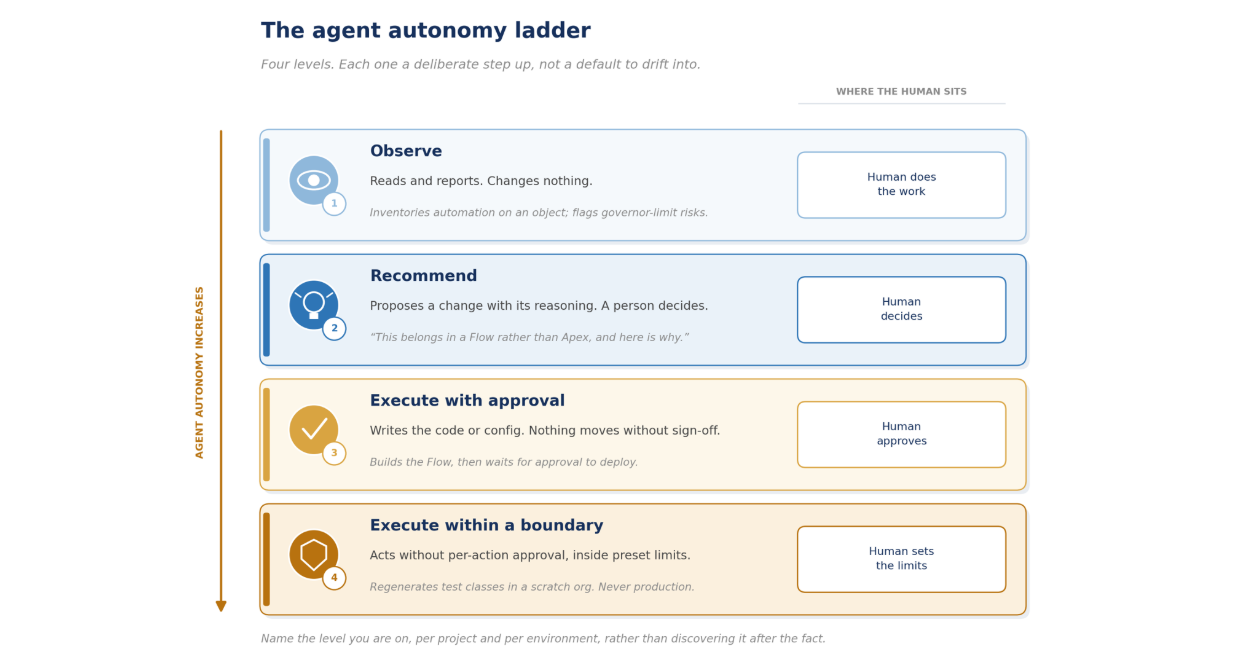
It’s an easy question to defer. Claude Code runs in a developer’s terminal with the same permissions as the developer who invoked it, so on day one it inherits whatever access that person already has. If that developer is a system administrator, the agent is effectively a system administrator too. Nothing about that is obviously wrong until the day an agent, working from a misread instruction or a poisoned file in a cloned repo, does something at machine speed that a developer would have caught.
The good news for Salesforce teams is that this is not a new discipline. Salesforce has spent fifteen years building controls for precisely this problem: how to let something that isn’t a full-time employee, a system integration, a contractor or a managed package, operate inside a customer org without handing it the keys.
Governing an AI agent is mostly a matter of pointing those existing controls at a new kind of user, and pairing them with the enterprise controls Anthropic has built on the Claude Code side. What makes Claude Code well suited to Salesforce work is not just that it’s capable, it’s that it was built with these controls as features, so the platform’s governance model and the agent’s governance model line up rather than fight each other.
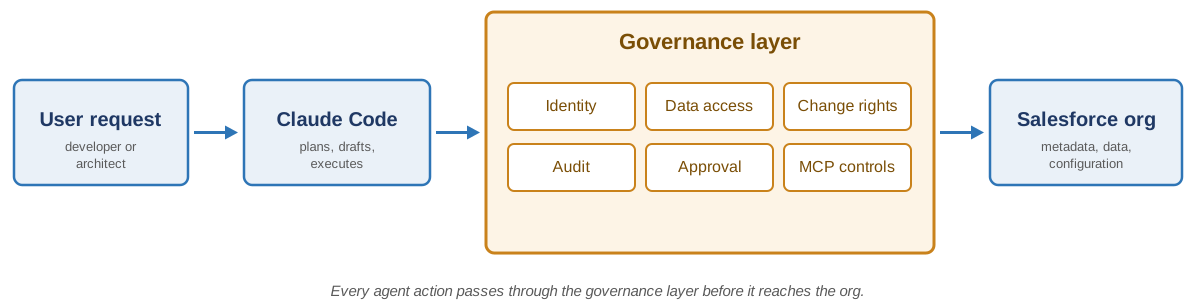
Every request travels the same path: the governance layer sits between the agent and the org
Before working through the controls, it helps to be concrete about what is actually being decided. Six questions broadly cover it, and a team that can answer all six has a governance model whether or not it calls it one:
- Whose identity does the agent act under?
- What data can it see?
- What can it change, and in which environment?
- Can you prove afterwards what it did?
- How far can it go before a person is involved?
- What can it reach beyond the org?
Each section below takes one of those questions and pairs the Salesforce control that answers it with the Claude Code control that enforces it.