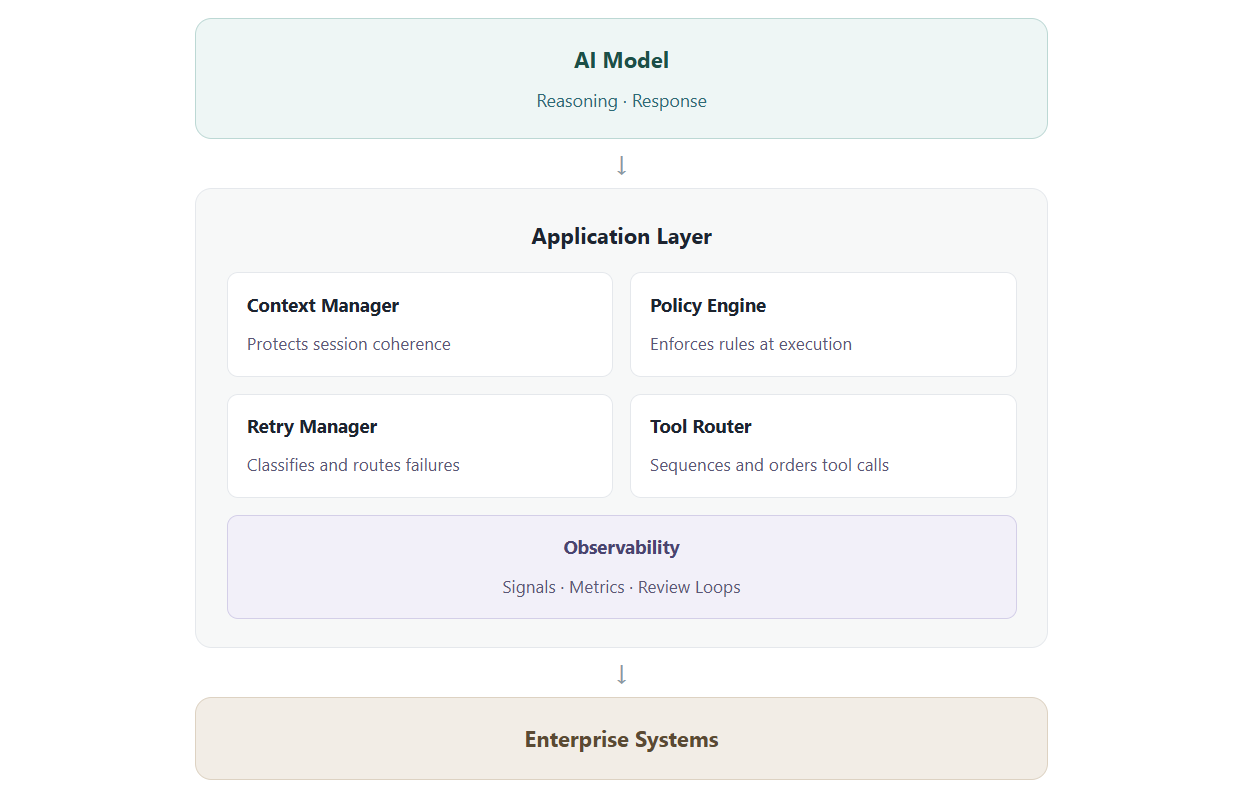
The financial services team spent a day isolating the root cause of their context decay failure. What they did not have was the week of signal that preceded it.
Session length distribution is one of the more reliable early indicators for context-related degradation. Their test sessions averaged 12 turns. Production sessions averaged 24 within the first week. That delta, logged and trended, is data you can act on before quality starts to slip.
Compliance intercepts serve a second purpose beyond policy enforcement: they are a data source. Each time the application layer blocks a model decision, that event reflects something about input distribution, edge-case volume, and whether prompt behavior is holding under production conditions. A stable intercept rate that begins climbing is worth investigating before the escalation queue surfaces it. Most teams treat the intercept log as a safety record. The more useful read is as a leading indicator.
Retry rate by failure category tells you whether the classification logic from pattern four is working in production. The aggregate rate is not enough on its own: you need the split between retry-receptive and retry-resistant failures to know whether the classifier is missing cases or escalating too aggressively.
Tool call sequences for pipeline-critical steps can be logged against expected orderings. It is an infrequent failure mode, which is precisely why it tends to go unnoticed when it occurs.
All of this is operational monitoring: it tells you the system is running without necessarily telling you whether the outputs it produces are correct. A system can clear every operational threshold cleanly and still be systematically wrong in a specific decision category. Confidence and correctness are not equivalent, and the gap between them is invisible in dashboards.
The only way to measure output correctness is to look at the outputs. Periodic sample review, weighted toward the domains with the highest error cost, is the minimum standard for compliance-sensitive workflows. When systematic errors surface in a specific category, lower the automation threshold until the pattern is understood. The feedback loop between reviewer findings and system configuration is where production governance actually closes.
| Failure Mode |
What to Instrument |
Watch For |
Response |
| Context Decay |
Session length + token count per turn |
Production sessions consistently exceeding test baseline |
Recalibrate context pruning filter |
| Pipeline Ordering |
Tool call sequence logs vs. expected order |
Any deviation from expected call sequence |
Investigate API constraint or prompt |
| Policy Compliance |
Application intercept rate over time |
Stable rate begins climbing |
Check input distribution shift or prompt degradation |
| Retry Logic |
Retry rate split by failure category |
Retry-resistant failures hitting the attempt ceiling |
Recalibrate the failure classifier |
| Tool Failures |
Failure rate by tool name and error category |
Rising rate for a specific tool |
Investigate before it surfaces to users |
| Output Correctness |
Periodic human sample review by decision domain |
Systematic errors in a specific category |
Lower automation threshold; feed findings into calibration |