I understand the instinct. When you are building something important, something that represents your organization, serves your customers, or automates a high-stakes process, using the most capable model feels like due diligence. Why risk a weaker model when the stakes are real?
But capability and fit are not the same thing. Sending every task to your most powerful model is like hiring a senior architect to hang picture frames. The capability is there. The fit is not. And over time, the misfit shows up everywhere: in latency your users notice, in costs that surprise you at scale, in systems that are harder to maintain than they need to be.
The question that drives better outcomes is not "which model is best?" It is "which model is right for this specific workload, at this volume, with these consequences attached?" Modern AI model families span a wide spectrum of capability, speed, and cost. The teams that understand how to navigate that spectrum build more reliable systems, serve their users better, and scale further.
What separates those teams is a practice with a name: workload architecture. It is the discipline of mapping each AI task against the model tier that fits its actual requirements across reasoning depth, latency tolerance, reliability, and the cost of failure.
In Brief
Context
Most enterprise AI deployments start with one model, sending every task to the most capable tier as due diligence. Over time the misfit shows up everywhere: in latency users notice, in costs that surprise at scale, in systems harder to maintain than they need to be.
Core Idea
The question that drives better outcomes is not “which model is best?” It is “which model is right for this specific workload, at this volume, with these consequences attached?” Five workload dimensions map to a model tier, and a routing layer makes that mapping operational.
Key Takeaway
Match the model to the workload. Getting the fit right is a performance and reliability decision first; cost efficiency follows naturally. Every mismatch has a cost, and you will find it eventually.
Before any model enters the conversation, map what the workload actually requires. Five dimensions determine where a task belongs on the capability spectrum.
- Reasoning depth is the first question to answer honestly. Classifying a support ticket into one of eight categories does not require the same cognitive load as synthesizing conflicting legal precedents or generating complex code under real constraints. If the work is pattern-matching, extraction, or routing, additional reasoning capacity goes unused. You are paying for depth the task will never call on.
- Latency tolerance varies more than most architects account for. A live customer interaction has a response ceiling the user feels in real time. A nightly batch process does not. Let the use case set the ceiling, not a general preference for speed.
- Error cost is the calibration input that matters most, and the one teams are least likely to map concretely before they ship. A misclassified support category gets rerouted in seconds. A misread contract clause lands in legal review. A flawed compliance assessment carries regulatory exposure. Know what a wrong answer actually costs in each domain before you decide how much reasoning to apply to it.
- Throughput determines operational sustainability at scale. A workflow processing 50,000 daily requests has fundamentally different requirements than one running 500. Volume is not an afterthought. It is a primary input to the architectural decision.
- Reliability is the dimension organizations add last, usually after a compliance finding or audit gap makes it impossible to ignore. Some workloads require not just accurate outputs but consistent ones. In regulated environments, variance across equivalent inputs creates downstream problems even when individual outputs are reasonable. If consistency is a hard requirement, treat it as a first-class criterion from the start.
Map these five dimensions to a workload profile. That profile points to a model tier. Getting this right is not primarily a cost decision. It is a performance and reliability decision. Cost efficiency follows when the fit is correct.
Your specific workload characteristics will shift some mappings. The value is in having a principled basis for making deliberate choices rather than defaulting to the same tier everywhere.
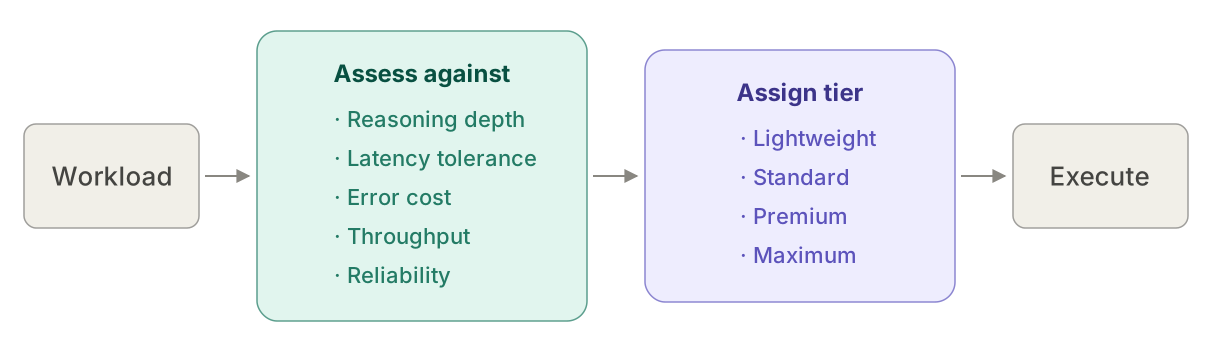
| Task Type | Reasoning Need | Latency Sensitivity | Throughput | Error Cost | Reliability Requirement | Recommended Tier |
|---|---|---|---|---|---|---|
| Intent classification / ticket routing | Low | High | High | Low | Standard | Lightweight / Fast |
| Real-time customer support responses | Medium | High | Medium | Medium | Standard | Standard Analytical |
| Structured data extraction at volume | Low-Medium | Low | High | Low-Medium | Standard | Lightweight + Batch |
| Document summarization and analysis | Medium-High | Low-Medium | Medium | Medium | Standard | Standard Analytical |
| Complex multi-step agentic workflows | High | Medium | Low-Medium | Medium-High | High | Premium |
| Legal / financial reasoning and synthesis | High | Low | Low | High | High | Premium |
| Long-running agents (multi-day, multi-stage) | Maximum | Low | Low | High | High | Maximum Capability |
| Research synthesis across conflicting sources | Maximum | Low | Low | High | High | Maximum Capability |
Reference Implementation: Claude
For teams building on the Claude model family, the tier mapping translates to specific models. Claude Haiku 4.5 covers the Lightweight / Fast tier at $1/$5 per million tokens. Claude Sonnet 5 covers the Standard Analytical tier at $3/$15 (introductory pricing of $2/$10 through August 2026; check Anthropic's pricing page for current rates). Claude Opus 4.8 covers the Premium tier at $5/$25. Claude Fable 5 covers Maximum Capability at $10/$50, purpose-built for long-running agents and complex research synthesis where no lighter model is sufficient. Prices were verified at the time of writing.
| “Each model earns its place in your architecture. None of them earns every place.” |
The classification step itself should always run on the fastest available model. Classifying a request is a lightweight task by definition. Use your fastest tier to do it.
In a Claude implementation, a lightweight Haiku call classifies each incoming request as simple, standard, or complex and routes it to Haiku, Sonnet, or Opus accordingly. The code is a handful of lines. The architectural value is in having the layer at all: a single point of control over what flows to which tier, one place to adjust mappings as the workload evolves, and clear visibility into where your compute is going.
Build the routing layer before you go live. Retrofitting it after a cost spike or a latency complaint is a harder conversation than designing it in from the start.
Design the pipeline, not just the request. Treat each stage of a workflow as its own routing decision. Ask what that stage actually requires across the five dimensions, then match the tier accordingly.
There is a resilience benefit here that often goes unacknowledged. A pipeline built across multiple tiers degrades gracefully when one tier is slow or unavailable. It falls back to a capable default for a provisional result rather than failing the request entirely. That tolerance is a design property. It does not appear by accident.
A retail organization spent eight weeks building their first enterprise AI deployment using the premium tier across the board. The demos had been compelling enough to remove any appetite for questioning the choice. They went live at 35,000 daily requests. Six weeks later, the monthly operational bill was 3.8x the original estimate. Volume had not changed. An audit showed 61% of requests were single-step intent classification: category routing, ticket triage, and return reason extraction. The lightweight tier would have handled every one of them, faster and at a fraction of the cost. Nobody had asked the question before they shipped.
In a Claude deployment, this pattern means Opus processing tasks that Haiku was designed for. The specific models are secondary. The failure mode is universal: a mismatch between what the workload requires and what the tier delivers, multiplied at scale.
| “The model choice you defer becomes the refactor you dread.” |
Make the tier decision before you ship. Build the routing layer early with conservative initial mappings, then refine them as real workload data comes in. Your future architecture will reflect the quality of the decisions you make now.
- System performance improves because each workload receives the reasoning depth it actually requires at the latency the use case demands. A customer-facing interaction routed to an under-provisioned tier produces outputs that feel thin and prompt follow-up. An internal analyst using an over-provisioned tier for routine extraction waits longer than the task justifies. Right-fit in both directions improves what people actually experience.
- Adoption is affected more directly by response time than most leaders account for at design stage. A tier that adds perceptible latency to a real-time workflow creates friction that accumulates gradually in usage patterns, workarounds, and eventually abandonment. Speed is a product decision with adoption consequences. Treat it as one.
- Resilience is an architectural outcome of having a routing layer at all. A deployment built on a single tier carries a single failure profile. A deployment with routing across multiple tiers absorbs degradation: when one tier underperforms, the pipeline continues at reduced capability rather than failing the request. Design this in from the start.
- Team productivity follows from documentation discipline. A routing configuration with a brief comment explaining the rationale at each mapping costs significantly less to maintain, debug, and extend than one built on unstated assumptions. When a performance issue surfaces six months from now, the team with documented tier choices finds the root cause quickly. The team without them spends days reconstructing decisions nobody recorded.
- Cost efficiency is real. It is also the natural consequence of making the right architectural decisions across performance, reliability, and user experience. Optimize for workload fit. Cost takes care of itself.
The practical starting point is the standard analytical tier as your baseline for most agentic and analytical workloads. It covers the majority of enterprise tasks at the right intersection of capability, speed, and reliability. Route lighter, high-volume work down to the fast tier. Escalate complex reasoning and high-stakes synthesis to the premium tier. Reserve maximum-capability tiers for workloads that genuinely require them.
Document every tier choice. A routing configuration with a brief rationale at each mapping is enough. That note becomes invaluable when you are diagnosing a production issue or planning the next phase of scale.
|
“Match the model to the workload. Every mismatch has a cost, and you will find it eventually.” |